

Station 1 · Videos 19, 146, 60
Type anything, see which tokens the AI cuts it into
AI doesn't read letter by letter. It reads tokens. Each colour below is one token. This is a real tokenizer, the same kind chatbots use.
The Token Kids: We are those tokens! Every sentence gets cut into a line of Token Kids before the AI reads it.
Same idea, two languages
Vietnamese usually costs more tokens because accented letters are rarer in training data. More tokens means higher cost and a context window that fills up faster (video 146).
Under the hood: what is a token inside the machine?
Each token is a number in a vocabulary of about 200,000 entries. Common words like “the” get a whole entry; rarer accented words are cut smaller. A ◇ marks a token that holds only half a character: one accented letter split in two.
This tokenizer is o200k_base, used by the GPT-4o models. Claude and Gemini each have their own, so counts differ a little, but the idea is the same.
Real prices differ by model; check the provider's page. Video 60 explains why every question costs money.
Station 6 · Videos 7, 242
Be the chatbot: pick the next word, one at a time
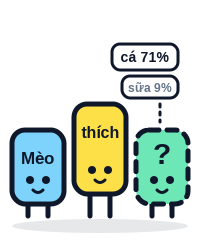
A chatbot really just guesses the next word, then repeats. Type a few words and the machine lists likely next words with their odds. Tap one to add it.
Under the hood: where did this guesser learn?
It read the 310 articles on this site (about 72,000 words) and counted which word tends to follow each pair of words.
Real chatbots learn from trillions of words and look at the whole conversation, not just the last 2 words. Seeing the whole sentence is what attention does (station 4).
Station 7 · Video 24
The lucky wheel: why the same question gets two answers
The AI scores every word it could say next, then draws one by those odds. Bigger slices win more often. The temperature knob makes the slices bulge or even out.
The thin mark is the original odds; the coloured bar is the odds after temperature. The number on the right counts wins.
Under the hood: the temperature formula
Each probability is raised to the power 1/temperature, then rescaled to add up to 100%. Temperature 0.5 makes big slices bigger; 2 pulls them together. Top-p keeps the biggest slices that add up to the chosen share and drops the rest.
Chat apps usually hide the temperature. The tip from the video: for creative tasks, regenerate a few times and pick the best; for exact tasks, ask the AI to work step by step and check itself.
Station 8 · Video 26
Think before answering: quick reply or careful draft?
Reasoning models are taught one more thing: write a draft first. Break the problem into steps, try, check, fix, and only then answer. Pick a question, let the AI answer right away, then let it think first, and see which one is right and which one costs more.
1. Pick a question
A pen and an eraser cost $1.10 together. The pen costs $1.00 more than the eraser. How much is the eraser?
2. Let the AI answer two ways
Guesses word by word; whatever comes out stays.
✏️ Scratch paper
Break it down, try, check, fix, then answer.

Press either button. Try both to compare.
Under the hood: when should you turn thinking on?
The draft is text the AI writes too, so it is billed per token and takes time. That's why thinking first is slower and costs more.
Turn it on for maths, trick questions, counting, planning and comparing many options. Turn it off for looking up a fact, translating a sentence or tidying up text. In chat apps it's a button like “Think”, or a model labelled “reasoning”.
The answers and drafts here are pre-written to illustrate the idea; no real AI is called. Seconds and token counts are rough estimates for comparison.
Found this useful? Send it to a friend
Everything runs on your device: no real AI calls, nothing is sent anywhere. The remaining stations open over time alongside the videos.